Before It All Turned
John Holten
What was the official title of this performance?
‘Eine LGB Barbarendurchbruch für die Veröffentlichung von Mountainislandglacier’ but the facebook event was called ‘Armory Show Preview & Press Conference: The LGB Group ⇒Europe ⇒ New York’ and this discrepancy doesn’t seem to have been ironed out.
So there was a Facebook event for the performance?
Yes of course, the organisers feeling this the most sensible method of inviting people, an audience being required for the performance’s full potential to be realized. Out of the 394 people Invited, 4 clicked ‘Maybe’, 50 clicked ‘Join’ and the rest, one is left to presume, either ignored it entirely or read the details but did nothing.
Where and when did the performance take place?
It took place at the Altes Finanzamt in Berlin, Neukölln on Tuesday, February 28, 2012 at roughly 8.49pm.
For what occasion was the performance?
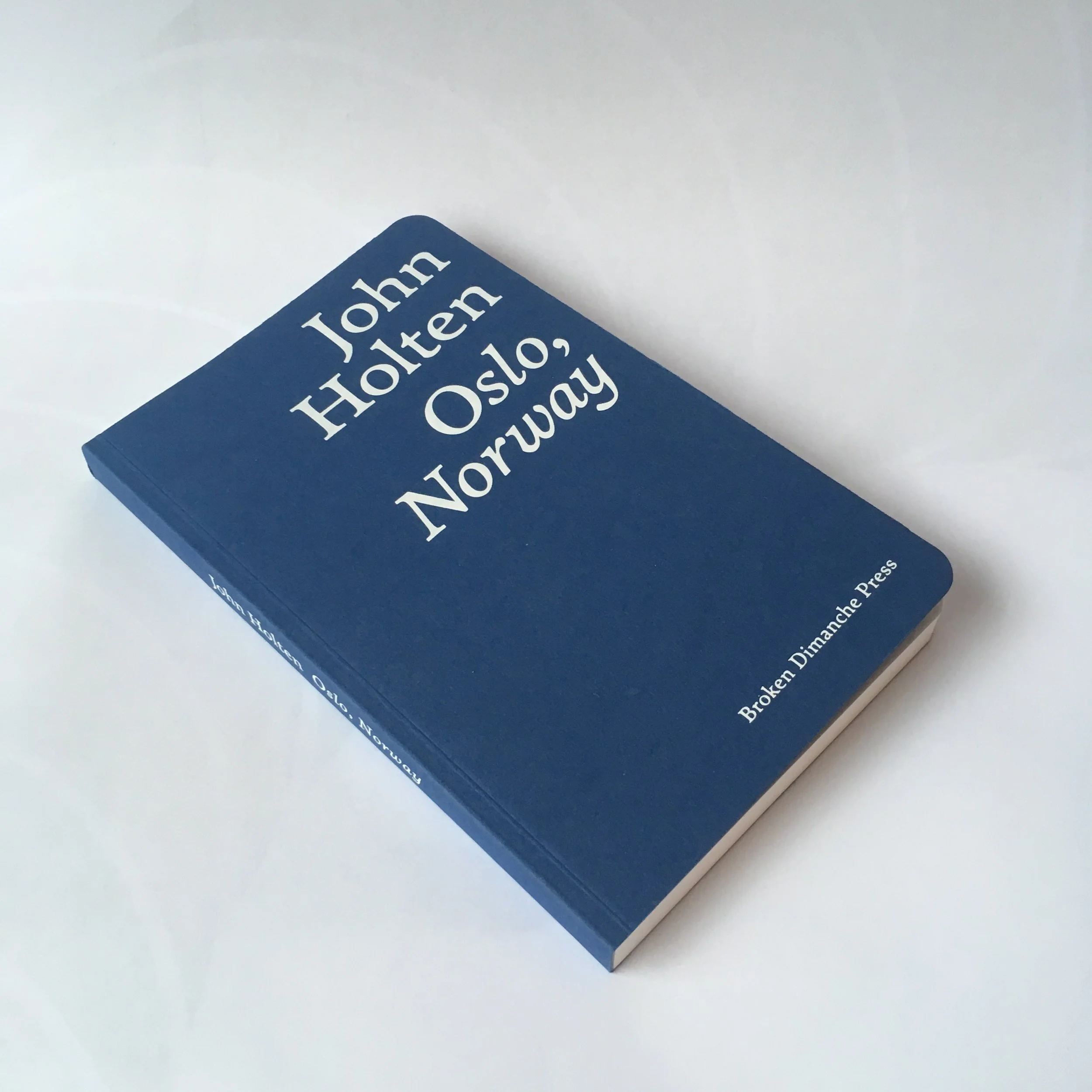
It was to stage a press conference for The LGB Group upon their inclusion in The Armory Show 2012 with Gallery D.O.R. (Oslo/Brussels) booth number 920, which was in the Nordic Focus. It was within the context of a book launch of Mountainislandglacier (Broken Dimanche Press, 2012) in which is a text about Djordje Bojic, cofounder and leading star of The LGB Group.
Why was it the Nordic Focus, aren’t The LGB Group mostly from the Balkans and Mitteleuropa?
Circumstance, happenstance, luck, blue drinks in a bar called ‘Ohne Ende’ on Berlin’s Dieffenbachstraße late one summer night et cetera, et cetera…
And what form did the performance take?
It took the form of one table at the head of a darkened room. Three people sat at the table, and one of them read a statement on The LGB Group’s final exhibition at The Armory Show. Behind them was a projection of the cover of the anthology Mountainislandglacier. The statement lasted four minutes and seventeen seconds and was followed by a question and answer session, like any good press conference.
Can you give an example of some of these Questions and Answers?
‘…’
‘It’s just natural to go over to America, eh…’
‘But isn’t the context different? Aren’t you afraid of being crushed by the sheer size of the buildings in New York City, for example by the weight, the materialist culture that is so prevalent there?’
‘Eh…yeah, yeah maybe we’re doomed but it’s alright because we’re going to be showing works in marble, and we believe that marble is a good substance – the gravestones that we’ll be showing will be made up of marble – strong, rocks, ehm, they will withstand decadent North America…but eh…yeah, thank you all very much. I think that’s enough. For more information you can go to galeriegojkovic.com.’
Who took part in the performance?
John Holten as John Holten from Paris, Darko Dragicevic as Milos Lubarda and Ida Bencke as herself representing Broken Dimanche Press.
Why ‘John Holten from Paris’? Doesn’t he live in Berlin?
This stems from the fact that the speculative real John Holten (who does indeed live in Berlin) has put himself into a relato-fictional position within his own novel The Readymades (Broken Dimanche Press, 2011). In this fiction it is this Borgesian John Holten who comes into contact with the fictionally real LGB Group and who puts in course a series of events that ends with the ontologically real objects at The Armory Show 2012. One could say that this kind of behaviour is becoming common practice within both contemporary literature and certainly contemporary art.
Whatever, when it’s at home, is relato-fiction?
It’s something that Holten (the other Holten, the one things happen to) hadn’t in mind when writing his novel, or indeed when performing as John Holten from Paris, it’s a term he came across in a piece of non-fiction by Roberto Bolaño (a writer who deeply influenced the writing of The Readymades, truth be told) that can be credited to Javier Cercas the Spanish novelist who ‘flirts with hybridization, with the “relato-real” or “true fiction”, with historical fiction, and with hyper-objective fiction…’ Michel Houellebecq did something very similar in his last novel The Map and the Territory, which also includes a visual artist as the main character. Then there’s David Shields’ manifesto ‘Reality Hunger’; in general there is sense that real life is more satisfying right now then fiction, made up things may be feeling tired.
What do you think?
Made up things have always felt tired and reality is nothing new.
Was the performance, at least within its own terms, what could be deemed a success?
That is hard to determine. There were a number of jokes, such as the incongruous line early on in the statement that ‘We’re all going to die.’ Nobody laughed: the audience took this information with a grim silence. It is likely that the audience did not know how to appreciate the performance fully, as the idea of what was real and what was a fiction was deliberately blurred by the performers. Some even doubted after the performance that the LGB Group was in fact on its way to the Armory Show. This can only be taken to be a considerable failure of a press conference that had as its main point of communication this very fact.
Has the performance been documented?
Of course.
Is it available online for instance?
Yes, you can watch it here: http://www.youtube.com/watch?v=slVQSr5xX1s
Could the performance be said to have a result?
Yes, it resulted in a number of people knowing about The LGB Group’s participation in The Armory Show, and through the publicity for the event, a wider audience being aware of the project in general terms.
Did the performers then leave for New York?
John Holten left two days later, by plane, via Brussels, and landed in New York around lunchtime on March 1. He spent two nights in Manhattan before boarding a bus to Baltimore, where he spent three nights, before returning and attending The Armory Show to see, as it were, the end point of this performance.
What could be said to be his overall sensations?
Discomfort, interest, wide-eyed interest and surprise, love and understanding toward America, a mythical America he knew nothing about but did his best to understand better (not without trouble, pain and sadness) and this all in turn could be said to have turned into equal parts regret and determination to go forth and continue with his relationship with art, America, fiction, performance, other people.